
CWS Window Replacement in Los Angeles: A Homeowner’s Guide
If you own a home in Los Angeles built between roughly 1985 and 2005, there’s a solid chance CWS windows are sitting in your walls right now. CWS (Custom Window Systems) supplied thousands of aluminum and vinyl units to Southern California tract developers during that building boom. When one fails, the replacement process is not the same as swapping out a generic big-box window, and the warranty situation surprises more homeowners than it should. Here’s what we’ve learned from replacing CWS units across LA for the past 16 years, including what the warranty actually covers, what it quietly excludes, and what a realistic replacement costs in 2026. If you’d rather skip the reading and just get a number, call (252) 675-6980 and we’ll walk you through it.
Key Takeaways for CWS Window Owners in Los Angeles
- The CWS manufacturer warranty covers the glass unit and frame components. It does not cover labor to remove and reinstall a failed unit, interior trim damage from that removal, or water damage caused by a failed seal.
- CWS windows appear most often in Los Angeles tract homes built from the 1980s through the early 2000s, especially in master-planned neighborhoods across the San Fernando Valley, Westside, and South Bay.
- Pocket replacement (reusing the existing frame) costs 30 – 40% less than full-frame replacement, but it is not always structurally possible on older CWS aluminum frames.
- A written installer workmanship warranty, like the 365-Day Done Right Promise from Hale Windows & Doors, covers what the CWS manufacturer warranty leaves out.
What Are CWS Windows and How Do You Know If You Have Them?
CWS, or Custom Window Systems, is a Florida-based manufacturer that supplied windows to home builders across the country during the late-20th-century tract housing boom. In Los Angeles, CWS units are most common in single-family homes built between 1985 and 2005, particularly in neighborhoods like Porter Ranch, Valencia, West Hills, Rancho Palos Verdes, and parts of the Inland Corridor and South Bay. These were builder-grade aluminum and early vinyl windows, often single-hung or horizontal sliders, installed in volume.
How do you identify a CWS window? Look for a small manufacturer sticker or etching on the glass corner or the frame edge. Many CWS aluminum units have a narrow frame profile with a distinct weep-hole pattern along the bottom track. The balance system, the part that helps a single-hung sash stay open, is often a spiral or block-and-tackle style. If you’re not sure, a photo sent to a specialist is the fastest way to confirm. In our experience, about a third of owners who call us saying “I think these are CWS” are correct, and the other two thirds have a similar-era product from a builder that used CWS on one phase of the tract and a different brand on the next phase.
The CWS Warranty: What It Actually Covers, and What It Doesn’t
Here’s where most Los Angeles homeowners get blindsided. The CWS manufacturer warranty on older units, typically a 10-year or limited lifetime glass warranty, covers the sealed glass unit, the frame profile, and in some cases the hardware. It does not cover the labor to remove a failed window from the opening, reinstall the replacement unit, repair or replace interior casing and drywall damaged during removal, or repair any moisture damage that occurred while the failed unit was leaking.
Think of it this way: if the glass seal fails and fog appears between the panes, CWS may send a new glass unit under warranty. But someone has to cut the old unit out, haul it to a recycling facility, install the new one, and patch the wall. On a second-story slider that requires scaffolding in a neighborhood like Sherman Oaks or Studio City, that labor can run $300 to $600 per window. Multiply that across a house with fourteen windows and the “free replacement” costs more than half of a full new installation. We tell every homeowner the same thing: the manufacturer warranty covers the part. Your installer’s workmanship warranty covers the reality.
That is exactly why our written job quotes at Hale Windows & Doors include a workmanship guarantee on every repair and replacement, plus the 365-Day Done Right Promise: if the work is not right within one year, we make it right. No argument needed. That layer of protection is not something the CWS factory warranty has ever offered.
What Does CWS Window Replacement Cost in Los Angeles in 2026?
Replacement pricing for CWS-style windows in Los Angeles depends on window type, framing method, and what brand you choose to replace them with. Hale installs and services eight professional-grade lines, including CWS, PGT, CGI, ES Windows, ECO Window Systems, Mr-Glass, Therma-Tru, and ViewLux. We match the right product to the job rather than pushing one brand. Here are realistic installed price ranges for Los Angeles in 2025 – 2026, including removal, installation, trim work, and disposal:
| Window Type | Pocket Replacement (per unit) | Full-Frame Replacement (per unit) |
|---|---|---|
| Single-hung, ~36″ x 60″ | $750 – $1,150 | $1,150 – $1,700 |
| Horizontal slider, ~60″ x 36″ | $900 – $1,350 | $1,350 – $2,000 |
| Picture window (fixed), ~48″ x 48″ | $600 – $950 | $950 – $1,450 |
These ranges reflect what we see across Los Angeles neighborhoods from Northridge to Torrance in early 2026. Permit costs, if the project triggers a structural review, add another $150 to $400 depending on the LA Department of Building and Safety scope. Most CWS pocket replacement jobs do not require permits when the frame and rough opening are unchanged. Full-frame replacement that alters drywall or stucco on exterior openings often does.
A quick note on why prices in LA run higher than the national median: stucco exterior walls, common on tract homes in the Valley and West LA, make full-frame extraction slower than vinyl-siding homes in other states. That’s real labor time, not markup.
Replacement Options: Pocket vs. Full-Frame for CWS Units
When a CWS unit fails in a Los Angeles home, the first technical question is whether the existing aluminum or vinyl frame can stay in place. A pocket replacement, sometimes called a retrofit, inserts a new window unit into the existing frame. It’s faster, cleaner, and typically costs 30 – 40% less than a full-frame replacement. We recommend pocket replacement when the original CWS frame is square, rot-free, and still thermally functional.
A full-frame replacement removes everything down to the rough opening: the frame, the sill, the interior casing, and the exterior stucco or siding returns. It’s the right choice when the original CWS frame has corroded in coastal neighborhoods like Playa del Rey or San Pedro, or when the home has settled enough that the original opening is no longer square. Full-frame also gives you the chance to upgrade glass packages, add low-E glass (a thin coating that blocks heat while letting light through), and address structural gaps around the opening. It costs more, takes longer, and creates a dust control problem that a good installer manages with containment and daily cleanup.
When we evaluate a CWS window in Los Angeles, we measure the frame’s squareness with a carpenter’s square, check for moisture intrusion at the corners with a moisture meter, and inspect the sealant around the exterior frame. Only after those readings do we recommend pocket or full-frame. We never push a more expensive full-frame replacement just because the margin is higher. The 365-Day Done Right Promise applies either way.
When to Call a Pro for CWS Window Replacement
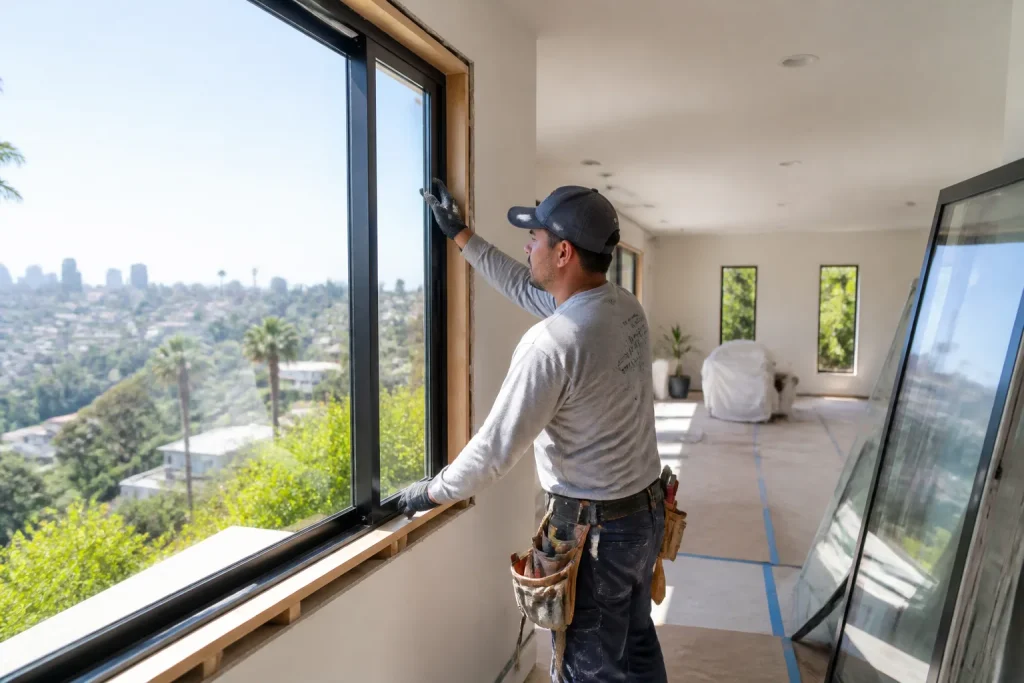
CWS windows are glued into the frame on many tract home installations, not set with removable stops. Removing one without the right tools and patience means broken glass, damaged stucco, and a window opening that suddenly is not water-tight. This is not a beginner DIY project. If you see fog between panes, feel drafts around the frame on an older CWS unit, or notice that a horizontal slider no longer locks because the track is bent, call a professional before water damage spreads into the wall cavity. In a neighborhood like Woodland Hills or Encino, a failed window seal goes unnoticed for months, and by the time the homeowner sees the drywall stain, the repair is no longer a window replacement; it’s a stud repair. Our team at Hale Windows & Doors evaluates every CWS job with that worst case in mind.
Related services in Los Angeles: Window Replacement in Los Angeles, Window Repair in Los Angeles, and Front Door Replacement in Los Angeles. All carry the same written-price policy before any work starts.
The Bottom Line
CWS windows in Los Angeles are a builder-grade product with a manufacturer warranty that covers parts but not labor, trim, or water damage. The replacement decision comes down to pocket versus full-frame, which affects both cost and disruption by 30 – 40%. Your best financial protection is a written installer workmanship warranty in your hands before the job starts. That’s what we give every homeowner at Hale Windows & Doors, along with the 365-Day Done Right Promise: if it is not done right, we make it right. No argument needed. If you’re in Los Angeles and want a written quote for CWS replacement, call (252) 675-6980 or visit the Hale Windows & Doors home page to see what we cover. The estimate is free, and the written price is yours before any work begins.
Frequently Asked Questions
Most CWS window replacements in Los Angeles run $600 to $1,700 per window installed in 2026, depending on whether it’s a fixed picture unit, a single-hung, or a horizontal slider, and whether the job is a pocket replacement or full-frame. Full-frame jobs at the upper end can reach $2,000 per unit on larger sliders. Call (252) 675-6980 for an exact quote, and we’ll put the written price in your hands before any work starts.
No. The CWS manufacturer warranty covers the sealed glass unit, frame, and sometimes hardware. It does not cover labor to remove and reinstall a failed unit, interior trim or drywall repair, or water damage from a failed seal. That gap is why we include a written workmanship guarantee on every repair and replacement at Hale Windows & Doors.
Often yes, but not always. If the original CWS aluminum frame is square, free of corrosion, and thermally intact, a pocket replacement saves you 30 – 40% versus full-frame. If the home has settled or the frame shows water intrusion, full-frame is the safer choice. We measure every opening before recommending either path.
Hale Windows & Doors installs and services eight professional-grade window and door lines, including PGT, CGI, CWS, ES Windows, ECO Window Systems, Mr-Glass, Therma-Tru, and ViewLux. We match the product to your home’s architecture, exposure, and budget rather than pushing one brand. Call (252) 675-6980 and we’ll tell you which ones make sense for your specific Los Angeles home.
Written by Spencer Odell, Owner at Hale Windows & Doors, serving Los Angeles since 2009.
Need Windows & Doors Help?
Call Hale Windows & Doors - licensed & insured, here with fast after-hours help in Los Angeles.
(252) 675-6980